

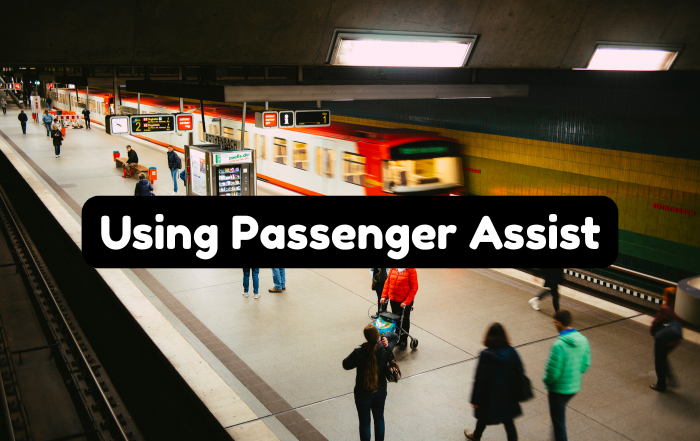
Growing up as a blind teenager, I had no idea how I would ever learn to travel independently. The thought of navigating huge stations and busy crowds terrified me. Then I discovered something called Passenger Assistance, and everything changed.
A Quick History of Accessibility
This year, the British railway is celebrating 200 years of passenger service. For a long time, the needs of disabled people were ignored. It wasn’t until the Disability Discrimination Act in 1995 that rail operators started taking their responsibilities seriously. Even today, there is still a lot of progress to make (only 56% of stations have step-free access in 2025). However, there are rules that require station staff to support disabled passengers – a service now known as Passenger Assist.
What is Passenger Assist?
It’s a free nationwide service that allows you to request support when travelling by train. Staff are trained to assist passengers with a range of impairments including vision, mobility and hearing. They can:
- Meet you at the station and guide you through concourses and ticket barriers
- Provide a guiding arm or a boarding ramp to help you on or off the train
- Carry luggage
- Help you to the train exit, or guide you to a taxi rank or your Uber point.
How do I request assistance?
There are two ways to do it.
- Booking in Advance
You can book using the Passenger Assistance app or by calling customer services. You’ll be asked for your departure station, destination, which train you want to take, and what support you need (for example, a guiding arm). When you’re starting out, booking ahead can help you feel more confident that staff will be available to assist. If you need to catch a specific train, booking also helps you avoid missing it. It’s recommended you arrive 20 minutes before your train so there’s enough time to get to the platform.
- Turn Up and Go
You may have to wait a little longer, especially when it’s busy, but staff are required to help you. Just turn up at the barriers and request the assistance you need. If the person you speak to is busy, they’ll find someone else.
What happens when I board the train?
Before you get on, staff will note your coach number and call through to your destination. That way, someone is ready and waiting to meet you when you arrive.
What if I need to change trains?
No problem! If you’ve booked, just make sure you include every station and time in your journey details. If you haven’t booked, tell the staff member where you’re going, and they will notify each station along the way.
What about the Underground?
Like mainline stations, Underground stations also have staff to help. When you get off your train, ask to be guided to the Underground. From there, they’ll help you onto the Tube and call ahead to ensure someone meets you at your destination.
Top Tips for Using Passenger Assistance
- Don’t ever be afraid to use it. Passenger assistance doesn’t make us less independent – it just makes travelling quicker and less stressful.
- Speak clearly and confidently. It can feel scary, but it helps staff notice you. If staff are expecting you, they should approach you anyway. Even when they aren’t expecting me, they often spot my cane and ask if I need help. If no one comes, don’t panic. You’re not on your own. If you have some vision, you might recognise the uniforms. If not, listen for voices, approach someone and say, “Excuse me.” If you think they’re staff, ask for assistance. If you’re unsure, ask if they can help you find a staff member. People are usually very willing to help.
- Build rapport with your local or most frequent station. Smaller stations often recognise regular travellers quickly. It’s also useful to keep the station’s direct assistance number. If I’m ten minutes away, I sometimes ring ahead and say, “Is anyone free to help me catch the next train?”
- Check the details. Before boarding, double-check that they will call ahead to your next station. They should, but it never hurts to confirm. Also ask which carriage they’re putting you in. Many trains have a designated disabled carriage, which often (but not always) has step-free access on the other side. Be alert when getting off.
- Don’t feel embarrassed. When I’m finding a seat, I’ve touched people and nearly sat on someone. I used to go bright red, but people should understand – and if they don’t, that’s their issue. You’ll probably never see them again.
- Listen carefully. There should be someone waiting for you at your destination, but still listen for audio announcements. If the train has no audio, count stops. If you have no useful vision, listen for the sound of doors beeping so you know where they are.
- If things go wrong, try not to panic. Like any service, Passenger Assist isn’t perfect. Sometimes you’ll get off the train and no one will be there. Maybe the previous station didn’t phone ahead or the destination didn’t record the information. In my experience, most of the time it goes smoothly. If no one is there, carefully step off the train in case there isn’t step-free access. Move forward a few steps so you’re clear of the doors, then stand still. Sometimes staff are just delayed. Because they already know which carriage you were in, it’s easier for them to find you if you stay in one place. If no staff appear, you can always ask a member of the public to help you find someone.


